The Aerospace Corporation is advising students and faculty from the University of Maryland (UMD) as they explore the creation and launch of a satellite designed to observe and photograph asteroid Apophis during its close approach to Earth in 2029.
A close pass by an asteroid as large as Apophis — named for the ancient Egyptian deity of chaos and darkness — is extraordinarily rare, occurring on average only once every 7,500 years. This historic flyby presents a significant opportunity for both planetary science and planetary defense. Although Apophis is classified as a potentially hazardous asteroid, it is expected to pass at a relatively safe distance of 5.9 Earth radii during the April 2029 flyby.
“The asteroid does not pose any threat to our planet in the next few decades,” said Nahum Melamed, senior project engineer for flight mechanics in Aerospace’s Defense Systems Group and co-developer of the NASA/JPL NEO Deflection App. “But we are going to use our experience from this encounter in case we need to go and characterize a rapidly approaching asteroid that we need to do something about on short notice.”
Aerospace’s Academic Alliances at Work
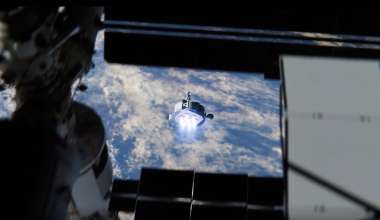
Students and researchers at UMD are developing a mission concept called Terrapin Engineered Rideshare Probe for Rapid-response Asteroid Apophis Profiling, Tracking, Observing and Reconnaissance (TERP RAPTOR). Designed as a small CubeSat-class satellite, TERP RAPTOR could launch as a rideshare into Earth orbit before executing a high-speed flyby of Apophis as it approaches. Its objective is to capture close-range imagery and data on the asteroid’s structure and behavior as it passes roughly 32,000 kilometers from Earth. If flown, it would be one of the few opportunities to obtain high-resolution in-situ observations of Apophis during the event, particularly if federal mission plans shift.
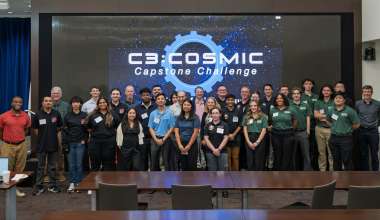
In October 2025, UMD’s research group traveled to Aerospace’s Technology Campus in El Segundo, Calif., supported by funding from two Aerospace initiatives — the University Partnership Program and Academic Alliances Program — to work on TERP RAPTOR alongside Aerospace subject matter experts in the Concurrent Design Center laboratory.
Aerospace’s support to the initiative originated through its Academic Alliances Program, which aligns Aerospace’s technical expertise with university partners to pursue next-generation capabilities, skills and technologies that meet emerging national priorities. The program fosters deep collaboration with academic institutions to advance research, education, and workforce development in fields essential to aerospace, space systems engineering and national security.
Why the Apophis Flyby Matters
The 2029 flyby offers an exceptional chance for spacecraft to observe how Earth’s gravitational field and magnetosphere interact with Apophis, enhancing scientific understanding of asteroid physics. Measuring asteroid properties is also vital for global planetary-defense efforts.
As Apophis approaches Earth, scientists will be able to observe a rare natural phenomenon in real time: the response of a near-Earth object to the planet’s gravitational pull. During its extremely close pass — nearer than many geostationary satellites — Apophis will even be visible to the naked eye across parts of the Eastern Hemisphere. Both ground-based observatories and space-based instruments will track subtle changes in its rotation, surface, and internal structure. These insights will refine impact-risk models and strengthen future mitigation strategies, transforming a moment of cosmic drama into a major scientific opportunity.
Advancing Capabilities, Advancing Planetary Defense Knowledge
Should humanity ever need to destroy or deflect a hazardous asteroid, the approach would depend entirely on its physical makeup — composition, density, and surface characteristics. A loosely bound rubble-pile asteroid behaves very differently from a solid metallic body, and each demands a distinct type of device, trajectory and force to alter its course. A deeper understanding of asteroid composition and structure will enable scientists to devise more effective planetary defense strategies in the future.
“Bringing this experience together with these students and this study gives us a chance to further advance capabilities available to industry and to the needs of entities that want to fly new missions and new concepts out there,” said Eric Breckheimer, assistant principal director of Aerospace’s Civil Systems Group.
Institutions interested in partnering with Aerospace through the Academic Alliances Program should contact [email protected].