In-space servicing, assembly and manufacturing (ISAM) capabilities such as autonomous manufacturing, on-orbit repair and modular space infrastructure are redefining how spacecraft are designed, maintained and sustained beyond Earth. These new technologies require an attuned and knowledgeable workforce to reach their full potential today and as they evolve in the years ahead.
Developing an ISAM-literate workforce has been a cornerstone focus for the Consortium for Space Mobility and ISAM Capabilities (COSMIC) since its founding by NASA in 2023. Managed by The Aerospace Corporation — a trusted, non-competitive partner advancing the space enterprise — COSMIC brings together industry, government and academia to accelerate ISAM’s evolution from concept to routine use. One of the consortium’s flagship programs is the COSMIC Capstone Challenge (C3), a nationwide student design competition aimed at strengthening the workforce needed to make ISAM a lasting reality.
Students Tackle Real-World Space Challenges
Originally launched as the Aerospace-led ISAM Design Challenge in 2022, the C3 competition has quickly grown in scope and ambition since COSMIC took it over in 2024. C3 invites participants to tackle real-world challenges in space operations through hands-on design, analysis and prototyping in response to an ISAM-themed prompt. Students can participate through coursework, clubs or independent study, making the program accessible to a wide and diverse pool of emerging talent.
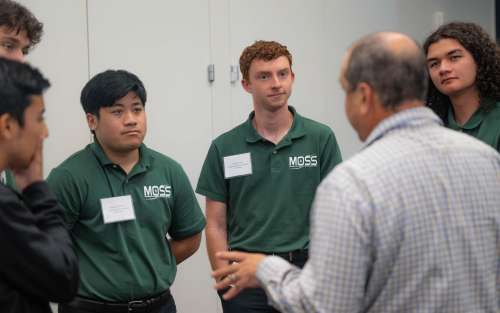
“The Capstone Challenge is essential to building the capabilities the global space industry will depend on in the decades ahead,” said Jacob Rome, the Aerospace senior project leader managing C3 for COSMIC. “Most professionals in the space industry today likely didn’t study ISAM in school, because this is such a new field. Connecting students with real-world challenges and experienced mentors helps cultivate a workforce that has the talent, skill and mindset needed to make these concepts operational across disciplines.”
At its core, C3 challenges students to think like mission designers, confronting with creativity and rigor the complexities of space systems in timely, real-world priority mission areas. The 2025-2026 competition expanded from one to four distinct tracks that collectively cover the spectrum of critical ISAM capabilities:
- In the Manufacturing track, teams designed payloads capable of executing multiple autonomous operations aboard an in-space platform, in this case the Arkisys Port via their Bosuns Locker — demonstrating the building blocks of space-based production.
- The Lunar Operations track pushed students to envision methods to develop infrastructure for a permanent human presence on the Moon, leveraging delivery systems like the Griffin lunar lander.
- In the Orbital Servicing track, participants designed modular spacecraft capable of autonomously maintaining and servicing satellites — incorporating features such as robotic arms, refueling ports and grappling systems.
- The In-Space Assembly or Construction track challenged teams to conceptualize large-scale infrastructure built through autonomous robotic assembly, drawing inspiration from efforts like NASA’s Project ARMADAS.
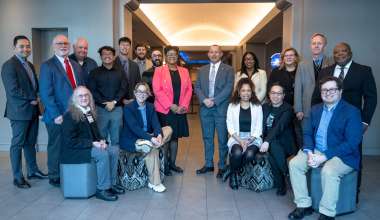
C3 has become one of COSMIC’s highest-engagement initiatives. This year’s competition drew more than 260 college students on 34 teams from 23 universities across the U.S. In mid-April these teams presented the results of a full year’s worth of concepting, tinkering and engineering at the C3 Final Showcase, hosted virtually and in person at Aerospace’s El Segundo campus, NASA’s Kennedy Space Center in Florida and the NASA Goddard Space Flight Center in Maryland.
After the results were tallied, Kennesaw State University’s Deep Interstellar Solutions team earned Best Project honors, while Virginia Tech’s C3PO team was awarded Best Prototype. The Best Mentor award, reflecting the critical role of mentorship in guiding student innovation, went to Matt Anderson, a senior project leader at Aerospace.
Connecting Talent with Industry Mentors and Opportunities
Beyond doling out awards, C3 connects aspiring engineers with professionals and opportunities in the broader space ecosystem through meaningful, real-world experience. Many C3 participants come from universities without dedicated space programs, making the competition a vital entry point into the industry for new blood and new ideas.
“We want the next generation of talent exposed to what’s changing the industry, and we want the industry exposed to new concepts,” said Rome. “The growth goes both ways. Sometimes it's students working on new problems who develop solutions that advance and entire field."
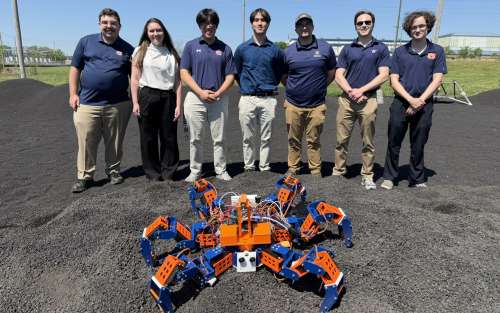
Through mentorship and collaboration with COSMIC member professionals, C3 students gain technical experience, personal development and a clearer understanding of how their skills can contribute to real-world missions. In turn, the industry gains timely new perspectives and proposed concepts as it explores new space frontiers, such as developing the lunar surface or returning products manufactured in space to Earth — a new fifth track planned for C3 next year.
“C3 has grown into something truly special,” said Aimee Hubble, Aerospace’s operations director for COSMIC. “This year, we saw an incredible level of technical depth and creativity from teams across the country. Students weren’t just proposing ideas; they were developing mission-ready concepts that reflect where the space industry is headed.”
As ISAM continues to reshape the possibilities of space exploration, programs like C3 ensure that the next generation is ready to realize its potential. By combining hands-on experience with expert mentorship, C3 is not only advancing technology — it is building the human foundation required to sustain it. In doing so, COSMIC, Aerospace and C3 mentors and judges are helping transform ISAM from an emerging concept into an enduring pillar of space operations.
To learn more about the participants in the 2025-2026 COSMIC Capstone Challenge, click here.
The next COSMIC Capstone Challenge will coincide with the 2026-2027 academic year. To participate, mentor or judge, visit cosmicspace.org/c3/.