

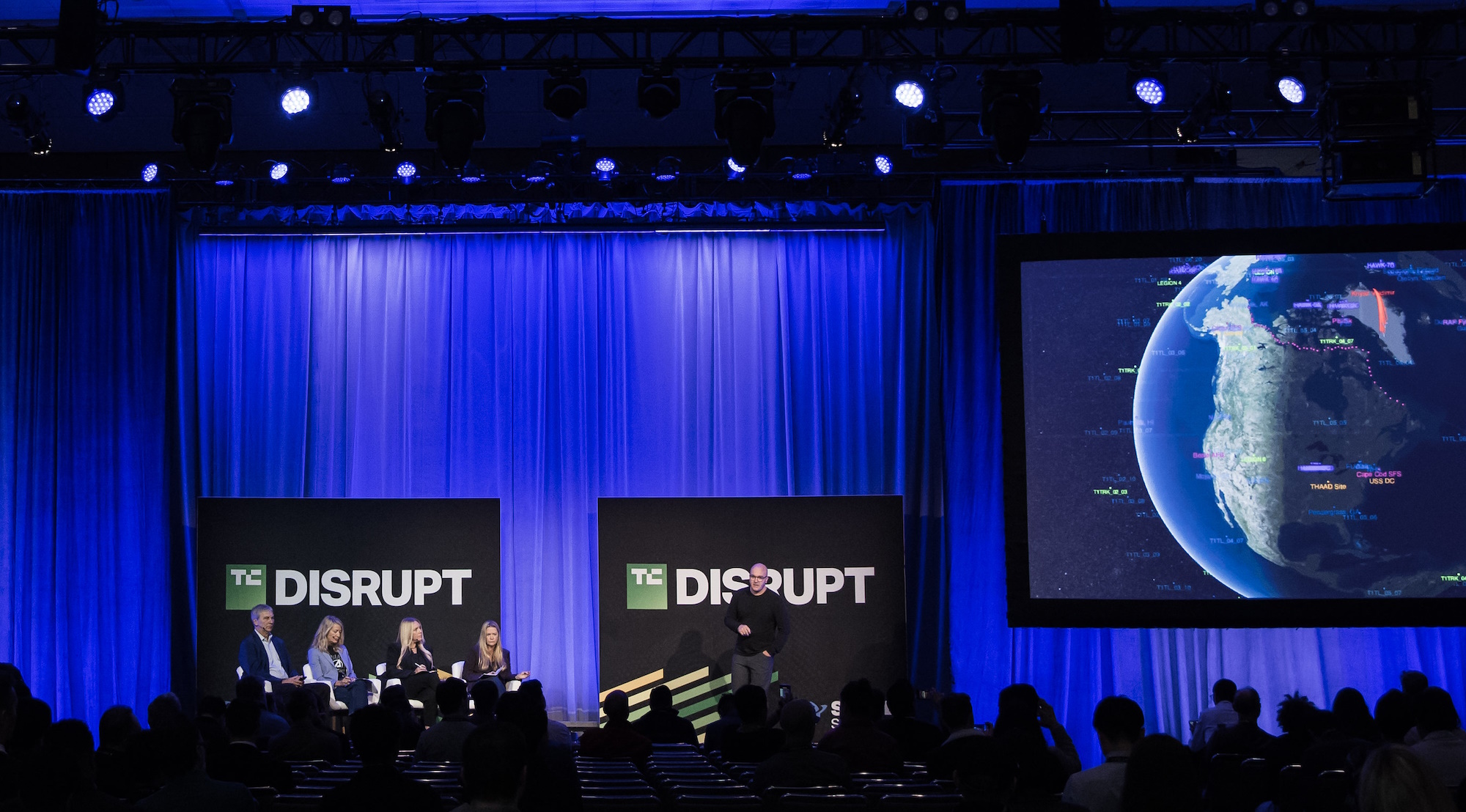
Simulations of orbital operations and threats are becoming increasingly important as the complexity of the space environment mounts. And existing sims aren't nearly fast or precise enough to keep up, claims Robbie Robertson, whose company Sedaro offers a new solution.
"What we're disrupting is the previous generation of simulation tools in this market that can't handle the integrated, distributed, and automated nature of the future systems that will define advantage in modern warfare," he said in a presentation on the Space Stage at TechCrunch Disrupt.
Generally speaking, he explained, there is a major trade-off in how well you can simulate, say, a satellite constellation or multi-missile attack. You can do it quickly, or precisely, or include many objects (from spacecraft to subsystems) in the process — but not all at once.
"With our platform, every node in that kill web can be simulated at full fidelity, all the subsystems, the components, and the associated physics," he said. "At runtime, it actually generates the multi-physics simulation engines and optimizes them to load balance across cloud infrastructure. This fundamentally differentiated tech allows us to deliver simulations that are at 100x scale and deliver them ten times faster than is possible with alternative solutions in the market."
Of course, such claims need serious documentation, but Sedaro has been working on that for years, through SBIR awards at first, and more recently, official contracts to provide this software as a service as an operational support tool.
"The value is that it's agile and it's adaptable, so if you change what you're asking the platform, you change your system design," he said. "It basically functions like a cloud OS, because we can build an app on top of that differentiated sim capability, to be a wargaming tool or be the operational decision support tool, or the AI training tool."
High-fidelity simulations are something future AI tools will need lots of, especially because of how limited actual events like proliferated threats actually are.
One judge asked about security, given this could be, as they put it, "a very ripe soft spot for bad actors to come in the back door" and observe or exfiltrate sensitive information or strategies.
Robertson responded that "our CTO knows more than he would like to about IT and cybersecurity now" after serving multiple contracts at secret level operations, not to mention the industry standard security practices any cloud-native company serving the defense industry needs to offer.
"As mega-constellations continue to scale, high-fidelity digital simulations like Sedaro’s are becoming increasingly valuable," said Aerospace CTO Debra Emmons. "Their approach points to a future where system modeling keeps pace with operational complexity."
You can learn more about Sedaro here, and watch Robertson's full pitch presentation here or in the video above.