

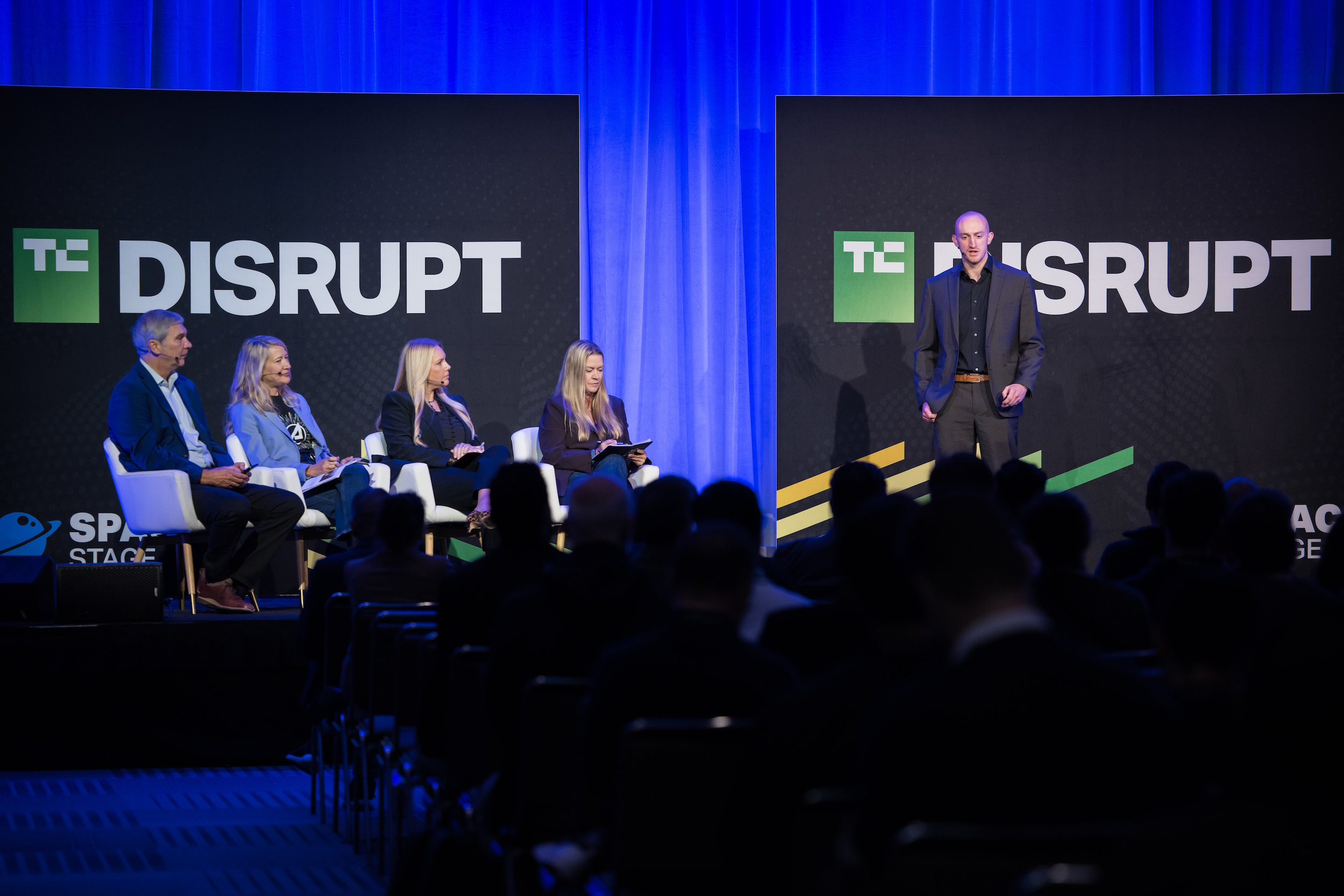
As orbital operations grow more numerous, complex, and time-sensitive, autonomous capabilities are increasingly in demand. Orbital Robotics is working on an autonomous arm and perception system that they hope will make things like on-orbit refueling and repair into routine tasks.
CEO and co-founder Aaron Borger explained on the Space Stage at TechCrunch Disrupt that while there are plenty of robotic arms in space, few if any have even the potential to perform the precise tracking and responsive movements necessary for this new generation of orbital operations.
"Our primary innovation lies in our deep reinforcement learning AI engine that allows for accounting for dynamic coupling while we can capture objects in orbit, as well as manipulating spacecraft," he said; "dynamic coupling" refers to when the target and the arm are moving relative to one another, but grasping is still successful.
Part of the Seattle-based company's secret sauce, he said, is in multi-factor verification of the vision task. For instance, if they want to identify and track a solar panel a spacecraft is attempting to adjust, they don't just rely on standard computer vision algorithms.
"We aren't doing that because it's hard to verify," Borger explained. "Our approach is more you take position, orientation, velocity, things like that, and then do very small actions. Each neural network is trained in maybe attitude control or translation control and we can verify each of those pieces."
The judges pointed out the difficulty of demonstrating such a sophisticated combination of hardware and software. Borger said that the company is doing as much as it can in simulation and terrestrial test beds, but that they have launches planned for next summer and fall to perform actual AI-directed operations.
And it's all in service, he said, of a fast-growing market.
"It's a little risky because we know we need to make our demonstrations work. But we've already talked to satellite operators and we know they need it. Our GEO customers have indicated they would pay thirty million dollars for a life extension, and LEO customers want to be able to maneuver without regret."
Aerospace CTO Debra Emmons commented on the potential of the company after its presentation, saying:
“Placing greater autonomy at the edge has the potential to make on-orbit systems safer, faster, and more responsive. Solutions like this will be important as orbital operations become more routine and more congested.”
Read more about Orbital Robotics at their website; you can also watch their full presentation here or in the video above.