

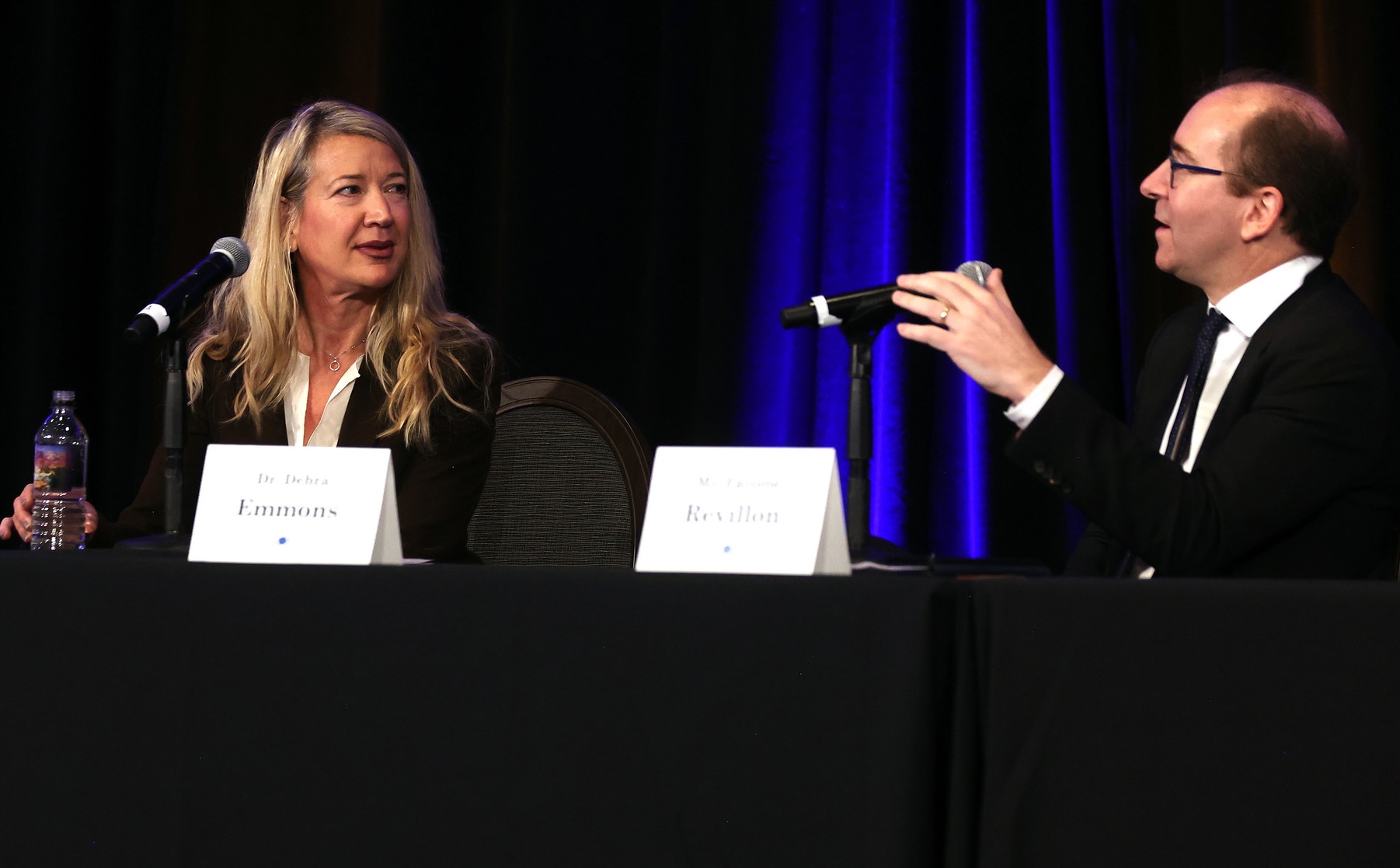
The amount of data going to and from space is increasing at unprecedented rates. It's no wonder that some think we should shift some of our terrestrial compute into orbit — and Aerospace CTO and VP Dr. Debra Emmons took the stage at Space Symposium to discuss the ambitious concept in detail.
Speaking with NovaSpace CEO Pacome Revillion, Emmons struck a balance between cautious optimism and being realistic about the challenges this concept faces.
"We are definitely at an inflection point here, and I think one can certainly envision the adoption curve evolving over time with near term, medium term and long term developments," she explained.
The near term, of course, is already here: edge compute. "This is where satellites are processing data where it's generated, not having to do that ground interaction. Earth observation is already being transformed by this — you're taking terabytes of data and, through that processing, turning it into kilobytes, and doing things that are actual intelligence on orbit."
The medium term is where things start getting hazy — but Emmons suggested proliferation is the likely next step: "Having satellite clusters working autonomously, that's going to be really important. Deep space missions require that: if you think about going off to Mars, well, that's up to 40 minute time delays. If you need to have the ground in the loop, that's not really practical."
When it comes to longer timelines, Emmons cited Aerospace analyses that suggested large scale datacenters are "still a ways out from reality," and that around 2040 is as early as we can confidently predict economic feasibility.
What's holding them back? A litany of technical challenges, from power to mass-to-orbit to the vulnerability of high-performance chips to radiation — many fields where commercial companies are innovating. But there is an additional challenge above and beyond each individual engineering breakthrough: integrating and testing a complete system.
"At the end of the day, it all comes down to integrating all of that into reliable, autonomous systems. You've got to think about redundancy at every level, about eliminating those single point failures. Software defined resilience is another way of thinking about that — systems that are able to detect failures and reconfigure automatically so you don't have one error rippling through and bringing your whole system down," she said.
"You know, you can get so far by doing ground testing, but really, making sure everything works together means you've got to do some of that in orbital testbeds. That's really where it all pulls together," Emmons concluded. "On orbit validation — at the end of the day, there's just no substitute for it."