

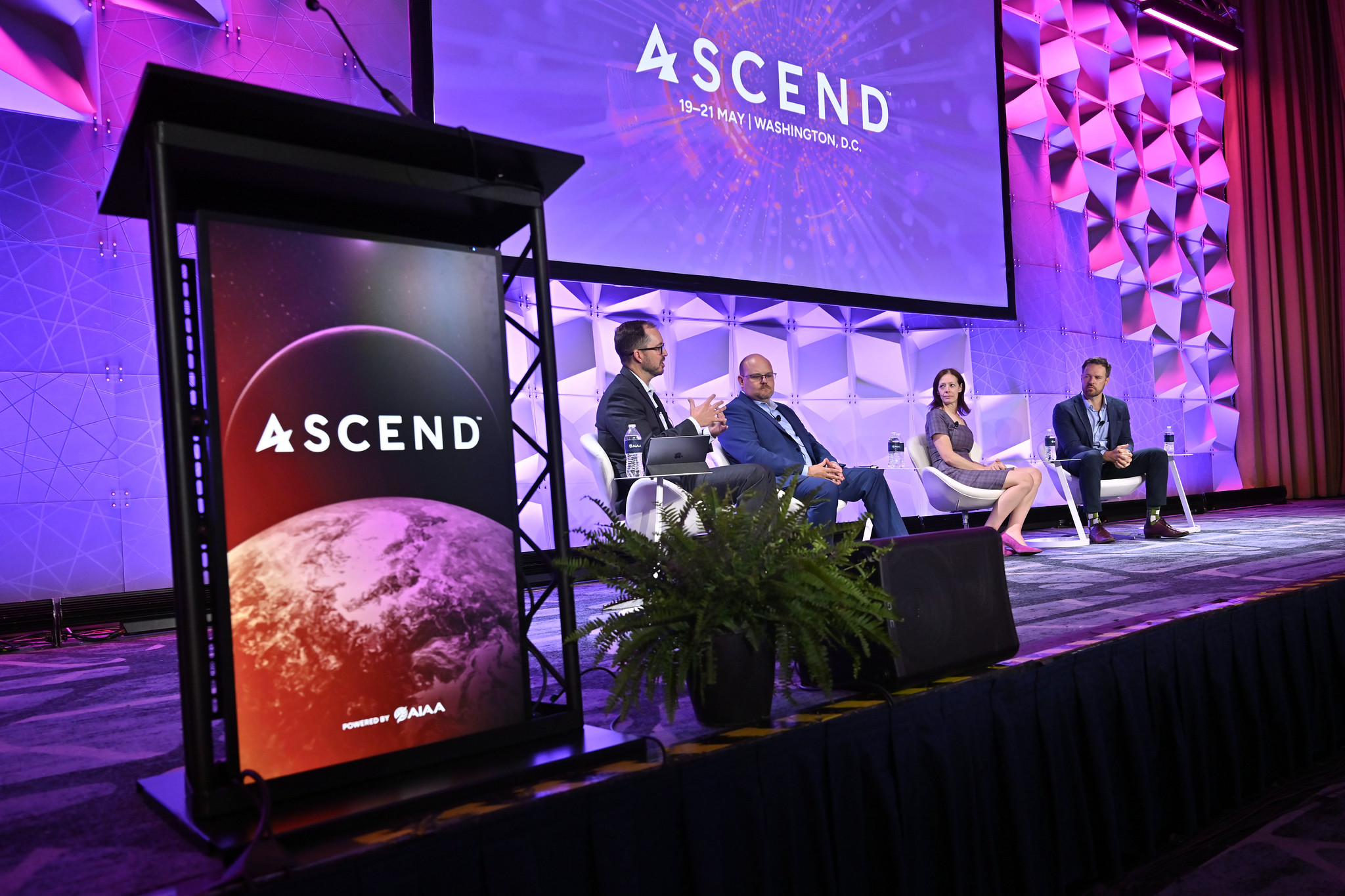
"Proximity is power" is how one panelist put it in a discussion of Very Low Earth Orbit (VLEO) at ASCEND in Washington, D.C. This niche orbit is attracting intense interest from government and commercial space organizations as the technology to operate within it matures.
The panel, moderated by The Aerospace Corporation deputy CTO Brian Cameron, featured Redwire's Spence Wise, VP of Missions and Platforms at Redwire, Steven Shepard, Co-Founder & CEO of Vaxon Space, and Dr. Gillian Bussey, Deputy Chief Science Officer of the US Space Force.
"There are lots of opportunities that are unlocked by VLEO: higher resolutions, lower power, a lot of exciting mission sets," said Cameron. "But also technical challenges in the blurring of the air domain and space domain at 200 to 250 kilometers. That requires a lot of technological innovation."
Wise pointed out that VLEO has been in use in highly specialized missions for decades, but what's different today is tech that allows "economic proliferation of the domain." In other words, it may be worth the cost even if the payload only lives for a month or two, a cost-management feat that wasn't possible even a few years ago.
The cost of flying VLEO assets has gone down, but Bussey pointed out that with lower power requirements and smaller antennas, "not only can you have COTS [commercial off-the-shelf] on the space segment, but you can have COTS on the ground segment. Our airmen, soldiers, seamen, and all our platforms are very SWaP [size, weight, and power] constrained — that makes things easier for the joint force."
She noted the success of DiskSat, a recent experimental VLEO satellite built by Aerospace, as a demonstration of the feasibility of this approach.
As Shepard pointed out, the benefits of better imagery and faster communications also lend themselves well to defense applications like missile detection and interception.
On the technical side, Wise asserted that "The science is done. The core science — material science, drag, space weather — these things have been measured. This is now a coupled systems engineering problem."
Logistical challenges also remain: for instance, no one launches direct to VLEO; you have have to go to LEO and drop down. And although interest is high, where investment will actually land in the short term is unclear, adding to risk. But if the enthusiasm of the panel is anything to judge by, this newly resurgent orbit will have a major part to play in the years to come.