

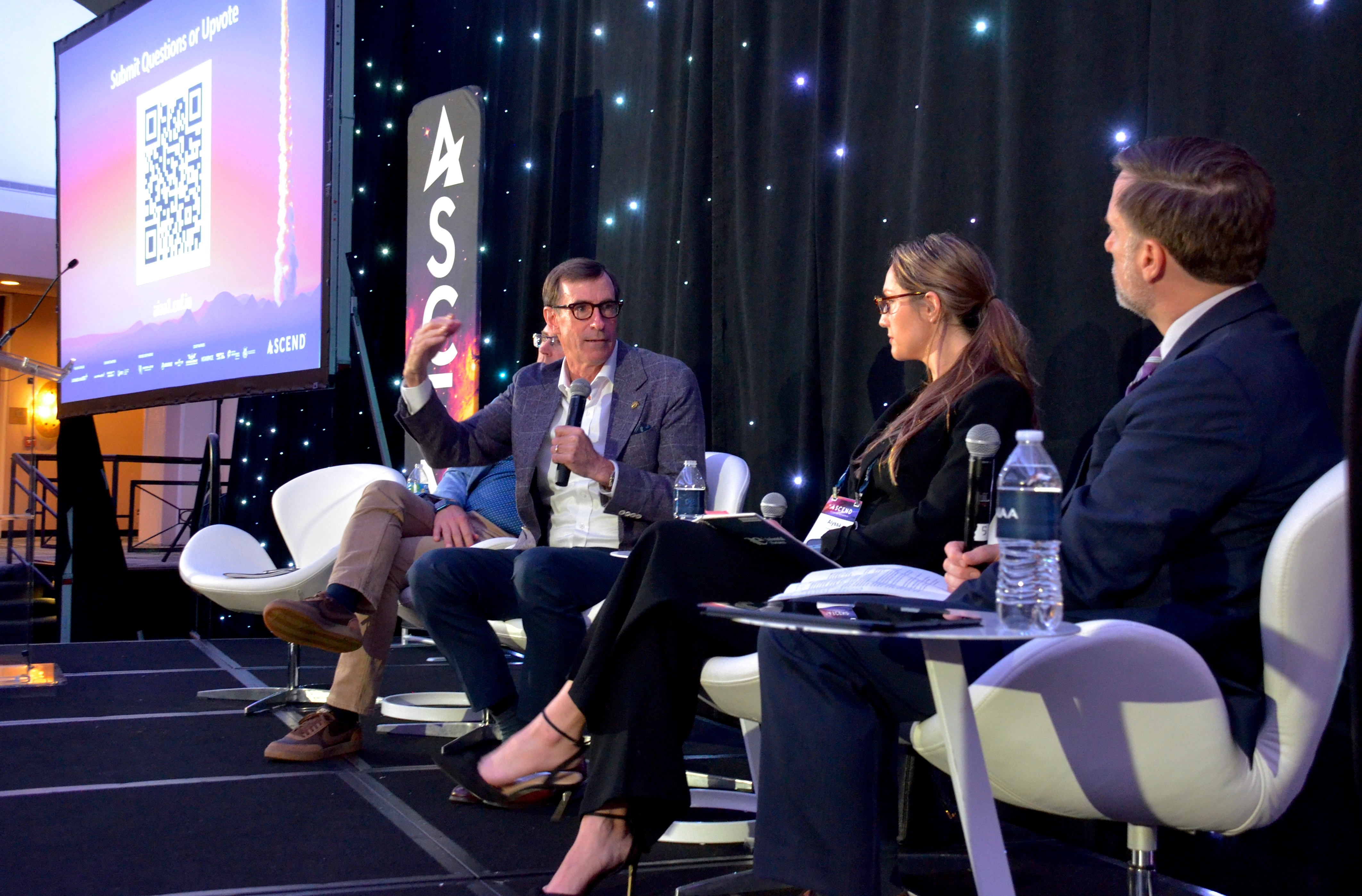
A lively panel of leaders in the space industry took on the question of how the U.S. can keep its edge in space with competitors nipping at our heels. In fact, argued one panelist provocatively, we might actually want to take a few notes from adversaries.
The panel was moderated by The Aerospace Corporation VP Defense Strategic Space Jamie Morin, who began with a high level lightning round: What is one thing the government can do to accelerate the space industrial base? You get one and only one vote.
"We need to be more like China," began Dave Cavossa, President of the Commercial Space Foundation (CSF) — getting a laugh from the room as he expanded on the idea. (He joked: "If anybody wants to be president of CSF, next week's a good time.")
"The Chinese are moving very, very quickly to overtake the United States when it comes to space dominance," he explained. "They're building the infrastructure on the ground, the spaceports, the launch pads. They're investing in satellite manufacturing and payload processing facilities all across the country. They have set a singular focus on beating the United States in space, and they can do that, in communism and a centrally planned economy, in a way that we can't."
Cavossa's point was well taken by the panel: dominance in space isn't determined by ideology, but by execution. And right now, he argued, China is doing what the U.S. can't, or won't.
Alyssa Goessler, VP at AE Industrial Partners, noted that while money is flowing to the sector, she doesn't always see clear shared incentives between investors and government entities.
AIAA President Clay Mowry concurred: "Industry's good at doing investing in the things they think they can get a return on invested capital in the five to ten year horizon. But in terms of mobility in space and the space environment, we need sustained development in some of the core technologies that are going to get us there. Those are more ten, even twenty-year time horizons. Developing fundamental technology is where we need to push."
Cavossa pointed out that this type of work is where the U.S. historically excels: going "from zero to one," as opposed to "from one to X," which is where he suggested is China's chosen expertise at present.
Goessler noted that the talent pipeline is still in dire need of maintenance, and not just pure STEM.
"I love engineers, I'm marrying one soon. They're great. But we also need welders! And we need the people putting all of these parts together. We need to be attracting these talent bases and fostering them over time," she said. "I feel like we've kind of seen this movie before, looking back at the Apollo era: as the budget for NASA decreased from its peak in the sixties, we lost institutional knowledge, we lost talent, and suppliers closed."
Mowry agreed, but suggested that space is arguably the hotter sector over tech these days, a reversal of a decade ago, which increases the talent pool. He recalled working with college students taking novel, AI-based approaches to space problems that deeply impressed him and implied the new generation is well equipped to join the space enterprise.