In just a few years, when a future Artemis mission crew leaves the pressurized environment of the Human Landing System to take humanity’s first small steps on the Moon in more than half a century, their every breath, movement and heartbeat will represent a giant leap of research into how humans survive beyond Earth’s protective atmosphere.
NASA astronauts, engineers and scientists conduct ongoing studies of atmospheric environments and extravehicular activity (EVA) systems, building upon a 60-year body of knowledge gained from international spacewalks and experiments. The resulting data are helping refine life support systems and EVA protocols for Artemis lunar missions and future Mars expeditions.
Several engineering teams at The Aerospace Corporation support NASA’s EVA and Human Surface Mobility Program (EHP), one of the critical programs within the Moon to Mars effort managed by NASA’s Exploration Systems Development Mission Directorate (ESDMD). The layers of Aerospace support to EHP help ensure that astronauts can adapt to varying conditions during long-duration spaceflight, directly influencing how humans will live and work on the Moon, Mars and beyond.
Guiding the Evolution of EVA from Space to Surface
Working outside a spacecraft has evolved dramatically since Ed White’s first American spacewalk in 1965 and other early EVAs, which were short and perilous. Today, astronauts routinely spend six to eight hours performing complex maintenance and research tasks outside the protective pressurized hull of the International Space Station (ISS). While the general public may find EVAs familiar enough given their increased frequency, they remain technically rigorous endeavors, with each requiring extensive planning, development, safety and mission assurance support from technical experts at Aerospace and teams across NASA.
NASA’s Artemis campaign will eventually establish a sustained human presence on and around the lunar surface, taking regular EVA operations to the next level. Astronauts will build and maintain habitats, deploy instruments and collect samples from regions never before explored, including the lunar south pole — home to permanently shadowed craters that may contain water ice. These groundbreaking activities will mark a giant technical leap forward for EVA, as they will take place in some of the harshest natural environments humans have ever set foot in. However, beyond the 15 moonwalks conducted by 12 Apollo astronauts from 1969-1972, there is no knowledge base written for them to be done “by the book.”
“There is no perfect analog for human spaceflight missions on Earth,” said Dr. Kara Beaton, chief engineer for Moon to Mars systems engineering and integration (SE&I) in Aerospace’s NASA Programs Division. “The ISS is the best spaceflight analog we have for extended exploration missions, but it’s a zero-gravity environment, so it’s not a perfect proxy for activities that will be done on the surface of the Moon or Mars.”
However, Beaton added, the space exploration community strategically designs terrestrial human-in-the-loop tests and full-scale, integrated simulation missions to study key spaceflight attributes such as reduced gravity, exploration atmospheres, EVA concepts of operations (CONOPS), human-robotic interactions, vehicle communication and navigation systems. Some tests take the form of analog missions, examining how space systems – like spacesuits and rovers – and human test participants alike respond in an integrated fashion within pressurized, alternate atmosphere environments over multiple days and weeks. These tests range in primary focus, from the performance of future hardware and mobility systems Artemis astronauts will use to the performance of the astronauts themselves.
Over the past half-century, NASA has utilized many test facilities in laboratories and in extreme natural environments around the world to define exploration CONOPS and capabilities, verify design-driving requirements and train ground controllers and astronauts for real missions. Findings from these tests ultimately allow NASA to gain a deeper understanding of the technical and operational challenges that must be overcome to enable successful crewed missions.
“Testing is absolutely a very powerful tool that we have, and we have some highly experienced engineers at Aerospace who bring centuries’ worth of combined analog test experience as a resource for the nation as well as the broader international exploration community,” said Beaton. This includes veterans of the space program dating back to the Apollo program, who understand the unique challenges of the lunar environment, working alongside relative newcomers in the Artemis generation who are contributing their expertise in various technical disciplines to help make new history.
No Pressure, No Problem
One of those relative newcomers – systems engineering analyst Alanna Carnevale – leads mass management and technical measure tracking within Aerospace’s SE&I team supporting NASA EHP at Johnson Space Center. This team, among other responsibilities, conducts integrated testing for NASA focused on risk reduction and requirement verification for a variety of Moon to Mars program elements.
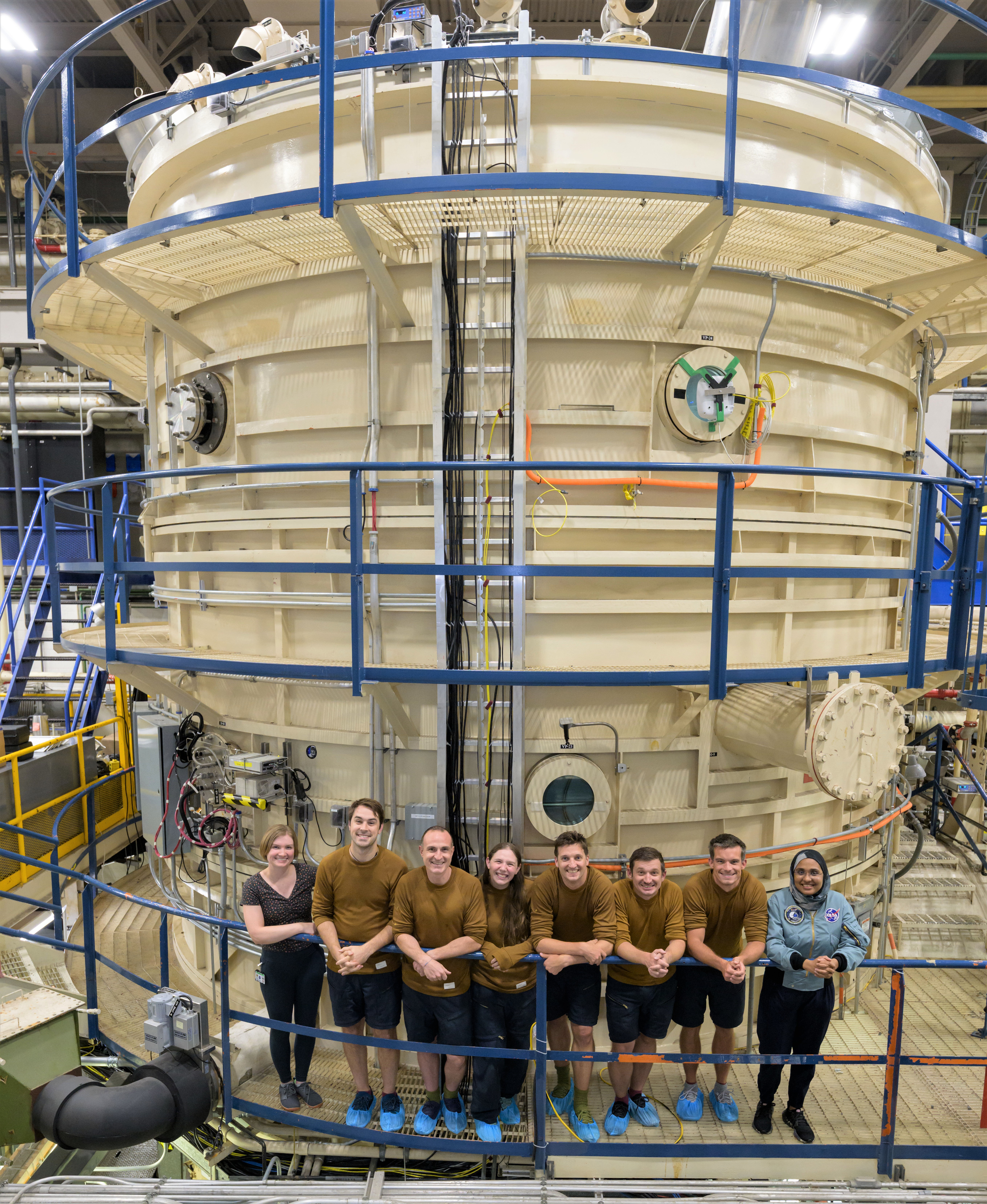
Stepping outside her regular role on the SE&I team, Carnevale was selected in Summer 2025 as a prime crew member for the sixth mission in NASA’s Exploration Atmosphere (EA) and EVA Protocol Validation Test Program. This series of analogs informs the design of pressurized habitats and suits and tests how different oxygen-nitrogen mixtures affect human physiology during decompression, transitions between cabin and suit pressures and long EVA durations.
This work ensures astronauts can move safely between habitats and suits without risking decompression sickness (DCS) — critical as NASA prepares for the Artemis program’s lunar surface operations. DCS, well-known among scuba divers as “the bends” can result from astronauts venturing from a higher-pressure environment such as a lunar surface habitat or Human Landing System into a lower-pressure environment such as the spacesuit required for conducting an EVA on the lunar surface.
“A central objective of the Exploration Atmosphere exercise is to mitigate the risk of DCS, which is higher on the lunar surface than during an EVA from the ISS,” said Carnevale. “A lot of effort was put into validating different protocols, such as adjusting the percentage of oxygen in the habitat environments or the pre-breathing of oxygen prior to embarking on an EVA to prevent nitrogen bubbles from forming. However, pre-breathing time can cut into valuable utilization or “science time,” so then it becomes a matter of balancing the two to maximize the benefit while minimizing risk.”
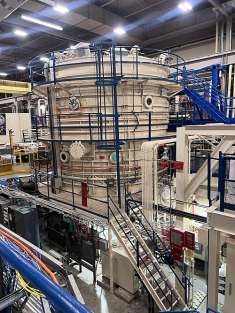
For the EA-6 mission, Carnevale and her crewmates descended into a hypobaric (low-pressure) chamber at Johnson for seven days and conducted 6-hour simulated EVAs on the final five days. (Fittingly, this test chamber was originally commissioned 60 years ago for the Apollo program.) NASA scientists and medical teams used Doppler tests and ultrasounds to monitor the crew members’ hearts during “EVAs” as they rotated between eight stations of low-intensity exercise emulating typical activities on the lunar surface — for example, kneeling as if changing a rover tire or weightlifting to simulate a cargo transfer.
The EA-6 mission was uniquely scheduled for participants to complete their simulated EVAs on consecutive days, rather than having “break” days in between, to assess any potential gains in the crew’s available mission utilization time. It also used a lower oxygen percentage than were used for missions EA-1 and -2 for a decreased flammability risk to the mission. The crew also enjoyed sampling the nutrient-dense food packages that will fly on the Human Landing System as a unique study component of EA-6, which tested the food’s higher caloric content against the mission’s strenuous EVA schedule.
The Human Element in the Loop
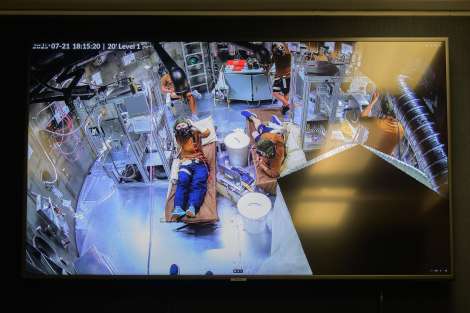
Apart from all the technology it involves, EVA research ultimately revolves around one simple goal: protecting and empowering the human beings at the center of it all. Every pressure gauge, ventilation system and mission schedule is designed so astronauts can focus not on survival, but on discovery and those designs are informed by compounding research.
Personal risks of entering the hypobaric environment aside, Carnevale was grateful for her opportunity to contribute to this body of research.
“There’s a lot of risk in general with this study, and I think that was one of the most impactful things on my mind, knowing we were able to accomplish that and make it through,” said Carnevale.
The findings from the EA-6 analog and other studies — each with contributions from hundreds of individuals like Carnevale and the other members of Aerospace’s SE&I team — will directly impact the future protocols for surface EVAs conducted during Artemis missions and future Mars missions. This research remains a cornerstone of exploration, embodying the intersection of science, engineering and human endurance and ensures that when the next generation of explorers steps onto new worlds, they will do so safely, confidently and ready to push the boundaries even further.
“Researching atmospheric environments and EVA systems isn’t just engineering – it’s building the bridge to our future in space,” said Carnevale. “Contributing to this research means shaping the systems future astronauts will rely upon and that’s a responsibility I carry with pride.”